Modelling highly biodiverse areas in Brazil
Ubirajara Oliveira, Britaldo Silveira Soares-Filho, Adalberto J. Santos, Adriano Pereira Paglia, Antonio D. Brescovit, Claudio J. B. de Carvalho, Daniel Paiva Silva, Daniella T. Rezende, Felipe Sá Fortes Leite, João Aguiar Nogueira Batista, João Paulo Peixoto Pena Barbosa, João Renato Stehmann, John S. Ascher, Marcelo Ferreira de Vasconcelos, Paulo De Marco, Peter Löwenberg-Neto, Priscila Guimarães Dias, Viviane Gianluppi Ferro
Our model aims to identify areas that encompass the most of species, endemism, evolutionary lineages and phylogenetic endemism in the smallest area. For this, our model has five main steps:
1 – Biogeographical regionalization (identify homogeneous spatial units in terms of species and phylogenetic composition);
2 – Weighted sum of quantitative biodiversity variables (species richness, species endemism, areas of endemism and phylogenetic endemism) in each unit of step 1 (in each unit the maximum value assumed is 1);
3 – Threshold to transform the result from step 2 into a binary map (identify areas with high biodiversity relevance);
4 – Sampling Effort incorporation (intersection between the result of step 3 and the sample effort map);
5 – Native vegetation remnants incorporation (intersection between the result of step 4 and the remnant vegetation map);
Thus, the final model presents categories that combine the degree of knowledge about the biota of the region and the degree of biological relevance of the area.

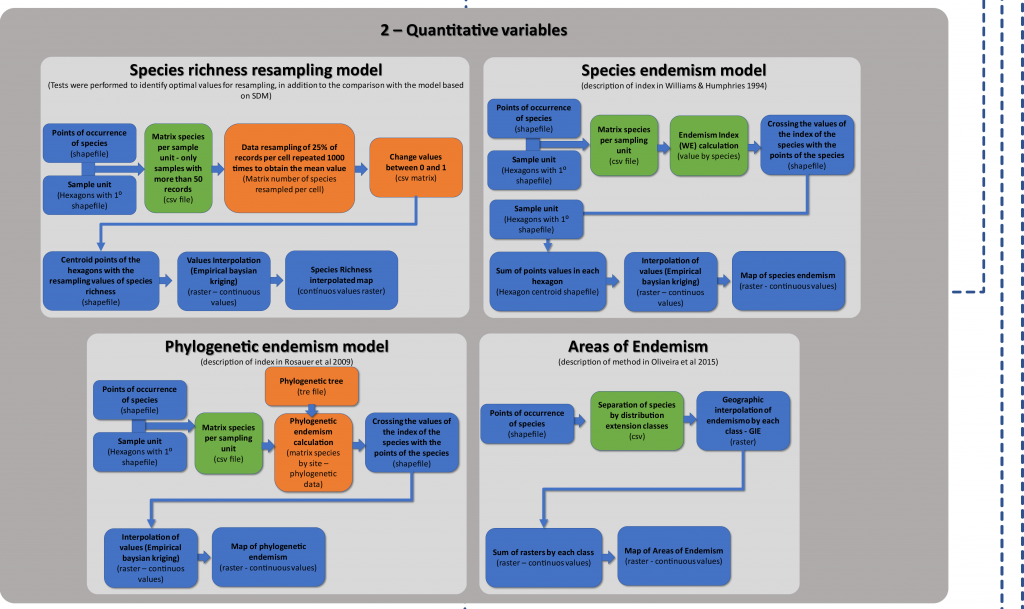
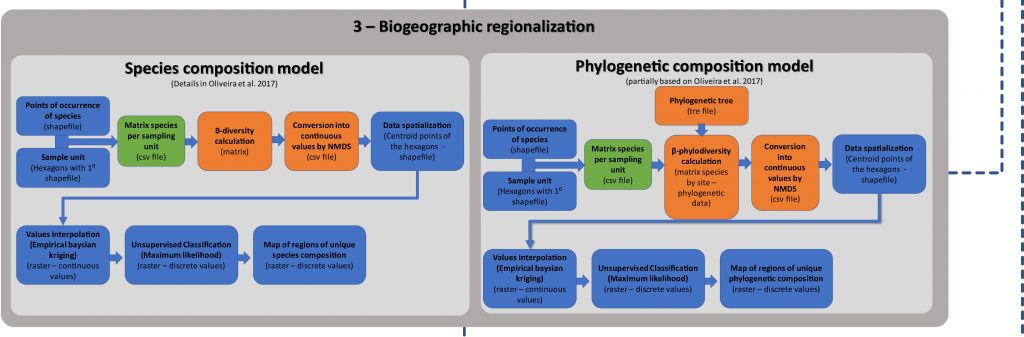
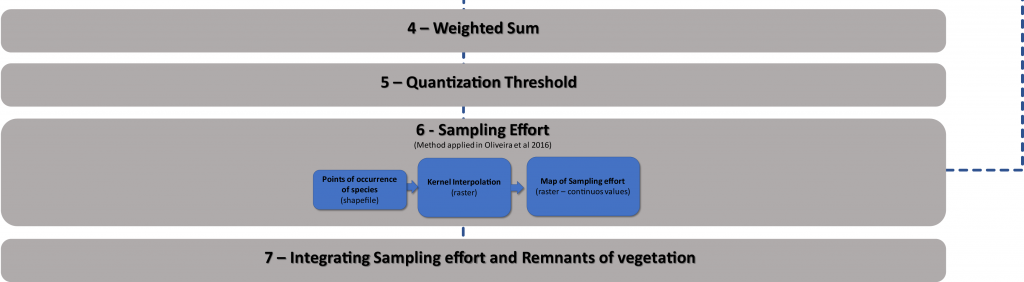
Model of relevant areas for biodiversity conservation in Brazil