Calc W. Of E. Probability Map (Calc Weights of Evidence Probability Map)
Description
This container calculates a probability map applying the Weights of Evidence method.
Inputs
| Name | Type | Description |
|---|---|---|
| Landscape | Categorical Map Type | Map of land use and cover classes. |
| Weights | Weights Type | Weights of Evidence coefficients. |
| Transitions | Transition Set Type | List of transitions for which spatial probability maps will be calculated. |
Optional Inputs
| Name | Type | Description | Default Value |
|---|---|---|---|
| Cell Type | Cell Type Type | Data cell type. | Unsigned 8 Bit Integer |
| Null Value | Null Value Type | Null value. | Default |
Output
| Name | Type | Description |
|---|---|---|
| Probabilities | Map Type | Map of probabilities. |
Group
Notes
The spatial transition probability maps depict the probability of a cell at position (x,y) to change from state i to state j. The spatial transition probabilities are calculated for each cell on the landscape raster map and for each specified transition. Dinamica employs the Weights of Evidence method, which uses a general polytomous logistic equation (see equation) to select the most favorable areas for each type of transition. The calculations are made using spatial variables stored in the GIS.
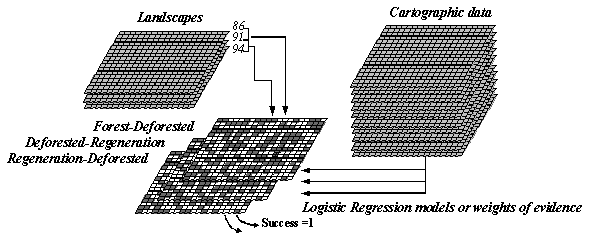
Cross-tabulation of multitemporal maps to produce transition probability maps.
Internal Name
CalcWOfEProbabilityMap
Usage examples
See practical examples of this functor in Lesson 18: Building a land-use and land-cover change simulation model